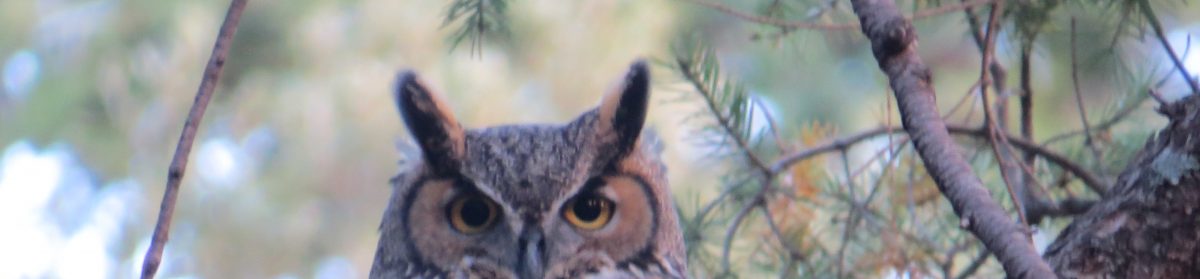
… duck … duck … Goose!

Greater White-fronted Goose, Tucson, Arizona

I’ve had my eye on this bird for a few weeks but I needed another reason to travel to Tucson before chasing it. News of Least Bittern at Sweetwater Wetlands this week turned the tide. I probably won’t find this goose any place else this year and I really hadn’t counted on seeing it at all. How easy was it to find it? How do you spell “Like shooting fish in a barrel”? So on to Sweetwater Wetlands. I see the City of Tucson has one-upped Sierra Vista with its name for its sewage ponds. Sweetwater! This reminds me of when I lived in Eureka, California with its pulp mills. The stuff coming out of the smokestacks, they assured us, that stuff that smelled like day old fish rolled in sulphur, was not only not unhealthy, it was good for you! Anyway, the closest I could get to a Least Bittern was:

American Bittern, Sweetwater Wetlands, Tucson, Arizona

That gets that one out of the way, maybe saving me some running around. After hours of searching for its little cousin, I reluctantly gave up the chase. Right before I left, I was approached by a group of non-birders. How did I know they were not of the birding brotherhood? Let’s just say that when I told the lady I was looking for a Least Bittern, she asked: “Is that a bird?” Fair enough. But the gentleman was far more sophisticated in all things avian. He proceeded to expound upon all the various and sundry species of birds he had seen of late – big ones, small ones, red ones, green ones, saving his best for last. With a twinkle in his eye and his chest out and chin up, he prodded: “Have y’all ever seen a Elegant Tragoon?” “Yes!”, I proudly reassured him, steadying my feet, “many, many times!” And finding no other sources of amusement in Tucson, I saddled up and left town. A lunch stop at Taco Bell topped off the day.

I added the following birds today: Greater White-fronted Goose/Orange-crowned Warbler/Green Heron/Blue-gray Gnatcatcher/American Bittern/Common Gallinule/Virginia Rail/Snowy Egret (162).

hopes still high

Miller Peak, Huachuca Mountains, Arizona

For the past two days I have been entering known Montezuma Quail habitat but still no luck yet. Yesterday I birded Blacktail Canyon, a little-known valley on the north end of the Huachucas. I added Rufous-crowned Sparrow but nothing else. Today I tried lower Carr Canyon, where I found a Rivoli’s Hummingbird at a feeder, and then Miller Canyon. It’s only a matter of time before I find the mythical Montezuma.

Corrigenda – On January 22 I went to Parker Canyon Lake to search for a reported Black Scoter. According to my eBird report I counted 50 Common Mergansers but neglected to add this one to the list. The scoter was reported by Diana Doyle, former editor of the column “Tools of the Trade” in ABA’s Birding magazine. Two days later she went back armed with her camera and discovered that the bird in question was instead a hybrid Pintail/Gadwall. Her pictures of this interesting cross are on eBird. For what it’s worth, this means I didn’t miss the target after all. So with the correction and additions, a little flim flam and hocus pocus, The List stands at 154. I see Henry Detwiler of Yuma is also running a Big Year and reports 328 species as of yesterday. Hmmm. That’s ok, I’ll take him out soon enough, he’s probably counting a bunch of introduced exotics or going to the zoo. I’m right behind him. Some broken glass, a few nails and some missing road signs might even things up. A gentleman’s contest? Not this Big Year.

one more

birding the San Pedro River

The fourth Saturday of the month is another bird walk day at the San Pedro House. I could be off chasing down birds for The List but I can do that here too. Not far along the trail, we spotted a low flying, high speed, get-out-of-my-way raptor that could only be – Merlin (151). With business taken care of, I could just enjoy a morning of birding. Lazuli Bunting is still present, Great Horned Owl in the scope, Louisiana Waterthrush on the river. A splendid day to be out. It looks cold, I know, but don’t worry, as they say here it’s a “dry” cold.

And now the answer to last week’s puzzler: why do the Cardinals need natural turf for their domed stadium? Out of the bags and bags of mail I received with thousands upon thousands of your letters, there was only one correct answer. And here it is submitted by Wilt Sodgrass – I think that’s how he spells it – of Weed, California. The entire field is on rollers and is rolled out into the parking lot during the week where it gets plenty of sun and water and then rolled back into the stadium for the game. Brilliant. Too bad they aren’t as smart at picking players for their team (Larry Fitzgerald excepted). Look for another puzzler in a coming post.

Now I have to face the fact that I am running out of winter birds around here to add to the list. Things could slow down until spring migration. I need something to keep me busy. Something a little bordering on fantasy. So I am making my next big target – gulp- Montezuma Quail. I know, I know I shouldn’t. You don’t find this bird – it finds you. Do NOT chase this bird. I know. But I can’t help it, I have to do something a little bit naughty every once in a while. Regrets? Full of them. Hopes? High as the sky.

keep on Rock-in’

“Upper ” Escapule Wash, Sierra Vista, Arizona

Birders know about Escapule Wash, running from Escapule Road to the San Pedro River. But one of my local patches that I enjoy all to myself is what I call Upper Escapule Wash, from Escapule Road up to Moson Road. I run a regular bird survey here too. It is part of the riparian conservation area so it is closed to vehicles. On only a few occasions have I seen anyone else in here. Let’s keep it that way. My goal today was to find Rock Wren and Crissal Thrasher here. The wren was easy:

Rock Wren, Upper Escapule Wash

… but the thrasher was not singing. They should be by now. I tried del Valle Road at San Pedro House but no luck there either. It’s a common bird so I’ll find one soon enough.

I couldn’t finish the day at just one new species so I stopped by the sewage ponds, the “park”, and rounded up a Western Meadowlark (150). Page 3 is now complete so here it is. Pages 1 and 2 are at the Jan 13 post. I only need a few more permanent residents around here so it may be time for another road trip soon.

Page 3

The Gilded Age

Scheelite Canyon, Huachuca Mountains, Arizona

Yesterday while leading a group on the Wednesday bird walk at the San Pedro House, a lady asked me about Gilded Flicker. I said 1 in a thousand flickers are Gilded around here. You need to go to Tucson to see one. I had never seen one here. I said that if we were good birders – and I think we are – we should carefully scrutinize every flicker. Within minutes a flicker appeared and I carefully scrutinized it. A Gilded Flicker!

Today I hiked Scheelite Canyon in search of Pacific Wren. I saw one here last year and there are eBird reports in here, but this is a tough one to get. Scheelite Canyon has special meaning for me and probably many other birders. I wonder how many people saw their life Spotted Owl here thanks to Smitty. I know I did. Smitty was a true old man of the mountains, the self-appointed guardian of the Spotted Owl. He kept a close eye on them and knew exactly where they were. He would be in position and you would slowly creep up to him, he pointed, and you saw it. Everything was done in hushed tones without sudden movements. I had the privilege of performing this ritual on August 16, 1996. My notes describe it as “a near religious experience.” Surely Smitty was the high priest of the Spotted Owls and Scheelite Canyon was his pulpit. Two years later he was gone. I searched hard today for another Spotted Owl in his memory but I couldn’t find one, even with Smitty’s spirit guiding me. Here is the marker at the base of the canyon memorializing his good work:

Scheelite Canyon, Huachuca Mountains

I added the following species today: Woodhouse’s Scrub-Jay/Steller’s Jay/White-throated Swift/Hutton’s Vireo/Northern Pygmy-Owl (148).

another chase

Parker Canyon Lake, Arizona

The biggest source of excitement for a Big Year comes from the thrill of the chase. It must be instinctive, it brings out your inner predator. Yesterday a Sierra Vista area birder found a Black Scoter at Parker Canyon Lake on the other side of the Huachucas. Black Scoter is only acidental in Arizona and it would be tough to get in New Hampshire in summer or in southern California in December. I got up early, stopped to renew my annual pass so I could cross Fort Huachuca, and flew direct to the “lake”. It was 32 degrees with a howling wind and there was no scoter in sight. Around the back side of the lake I ran into another birder who said he had the bird. We’re looking for a female scoter and this was a dark duck with a white face patch. (“My good sir, that is a Ruddy Duck!”) Back I went to the starting point but after a few hours, no scoter. As can be expected, all was not lost. I found a Common Goldeneye, which could be hard elsewhere, and a Hooded Merganser, supposedly rare here:

Hooded Merganser

I checked a few more places around the fort on the way back but couldn’t find anything new. Up the total to 142. Tomorrow I have bird guide duties so Thursday I may try to round up a few more local common ones to pad The List.

LeConte’s Corner

I decided to make the Buckeye trip an overnighter afterall. I took a room in Gila Bend and since it was a Saturday night, I had to make a night of it on the old town. I took in the opera, theater, museums, and the arts. I indulged in the leafy parks, elm-shaded boulevards, and unique architecture. Here is my shot of downtown Gila Bend, Arizona, replete with soaring church spires, neon lights, and hustle and bustle. See for yourself:

Gila Bend, Arizona


I got out of that place as fast as I could. I arrived at the thrasher spot before sunrise met by silence but in a few minutes I heard a thrasher singing and saw a pale, long-tailed bird singing. Once I got close enough to see the dark eye in the scope, I had the bird, LeConte’s Thrasher. This is a good one for me. Every year I would search for it when I visited my parents in Palm Springs for Thanksgiving, but I never saw one. Last year I came to Buckeye like a pilgrim to Mecca and found one, my first. This year I came back. I had to come back. To add it to The List.

LeConte’s Thrasher, Buckeye, Arizona

After picking up Sagebrush Sparrow, next stop was nearby Robbins Butte Wildlife Area where I thrashed around for a Bell’s Sparrow but I was never certain enough to call it; there are Sagebrush Sparrows in here too. That’s OK, I can get this one in San Diego in December. On to Santa Cruz Flats for what should have been a sure Mountain Plover at Evergreen Turf Farm, where they crow that they are the official provider of fresh natural turf for the Arizona Cardinals. So here is today’s puzzler: the Cardinals play in a domed stadium. Why do they need natural grass from a sod farm? Look for the answer in an upcoming post. A thorough search failed to turn up a single plover, and none at the West Coast Turf Farm either. A major disappointment. I’d hate to come back and I don’t know if I can get it in Colorado in August. A car full of birders passing by also failed to find one, much to my relief. Others’ failures is good company in this sport. I jumped out of the car for a close Prairie Falcon but, finding no caracaras, I called it a day. I added the following birds today to The List: LeConte’s Thrasher, Sagebrush Sparrow, Great Egret, American Pipit, and Least Sandpiper, pushing the total to 140.

of bluebirds and jigsaws

Yesterday it occurred to me there is a strong parallel between doing a jigsaw puzzle and a Big Year. Each time you place a piece of a puzzle, you have one less in the pool, making it that much easier to find the next piece you need. And each time you find the one you need, and it fits exactly into place, without ambiguity, you get a sensation of getting a hit, catching a pass, hitting a basket. The same for a Big Year. Every time I find a new species I can forget about that one and I can focus on the remaining targets. I’m that much closer to finishing the puzzle.

There’s more! Jigsaw puzzling requires the careful study and analysis of size, shape, and color. That’s birding! Birders should by all rights make excellent jigsaw puzzlers. I predict that when the day comes that jigsaw puzzles are an olympic sport, birders will come away with the gold medal.

Acting on another tip, my target today was Western Bluebird, another winter visitor I need to get out of the way. I went up to Brown Canyon Ranch for a look but nothing there. Farther up Ramsey Canyon Road, as I was turning around, I looked over my shoulder and there were 2 bluebirds on the wire: Eastern! Not what I was looking for but new for the list so I’ll take it (133). Farther down Ramsey Canyon Road, at the corner of Desert Storm Drive (patriotic exuberance?) I saw 2 bluebirds on the wire. Then about a dozen gathered. Western! (134)

Western Bluebird, Sierra Vista, Arizona

I like them served up nice and easy. My day was done at 8:40.

Tomorrow I have a special bird guide duty for photographers at San Pedro House then on Sunday I take a special road trip to Buckeye for the rare and elusive LeConte’s Thrasher and other specialties. The List is growing; the pieces are falling into place.

Say what?

I stopped in here after guiding at San Pedro House this morning. What is the Environmental Operations Park? Audacity at its finest. It’s the city sewage ponds! Imagine calling it a park! Like you might want to bring a picnic basket. You could, but stay out of the chocolate milk. In fact, this is one of our better birding hotspots. The city lets us enter the entire “park” on Sunday mornings on an organized bird walk. You can drive in part way Mon-Fri and have a look around. There are a couple of things over here that I need for the list. As a flock of ducks took off the lead bird was Lesser Scaup, number 133. Next Sunday I’m headed to Buckeye for “The Thrasher”, so maybe the week after I will take a walk through the park. Notice the hummingbird on the sign, the rare and elusive Crimson-throated Blue-backed Hummingbird. Sierra Vista bills itself as “The Hummingbird Capital of the United States”, and rightly so.

two good ones

Sandhill Cranes, Sulphur Springs Valley, Arizona

The Sulphur Springs Valley, one valley over to the east, is best known for the many thousands of Sandhill Cranes that winter there. But there are a few other specialties here, some of which I saw earlier this month, and some of which I missed. I had to go back today for Ferruginous Hawk and Bendire’s Thrasher. Also possible was Sagebrush Sparrow and Golden Eagle. After driving around a little I went up Mormon Road and found this thrasher perched out in the open:

Bendire’s Thrasher, Sulphur Springs Valley, Arizona

Notice how the bill is shorter and less decurved than Curve-billed Thrasher. But if those field marks are too flimsy, notice how the bill is pale at the base. That clinches it – Bendire’s Thrasher! Now I just had to drive around some more to find the hawk. I took a short detour to search for Sagebrush Sparrow without luck but I can get that when I go for LeConte’s Thrasher in a couple of days. Around and around I went until a light colored hawk flew out and directly over me. I could see every detail – Ferruginous Hawk. But I wanted a picture and this bird was long gone. On the way out of the valley I saw another pale-colored hawk perched near the road:

Ferruginous Hawk, Sulphur Springs Valley, Arizona

A second Ferruginous Hawk! Time to pack it in. I’ll just have to run into a Golden Eagle somewhere else, there is no particular place to go to to search for it. So two good target species crossed off the list. Tomorrow I have bird guide duty at the San Pedro House; maybe we’ll get a Merlin.