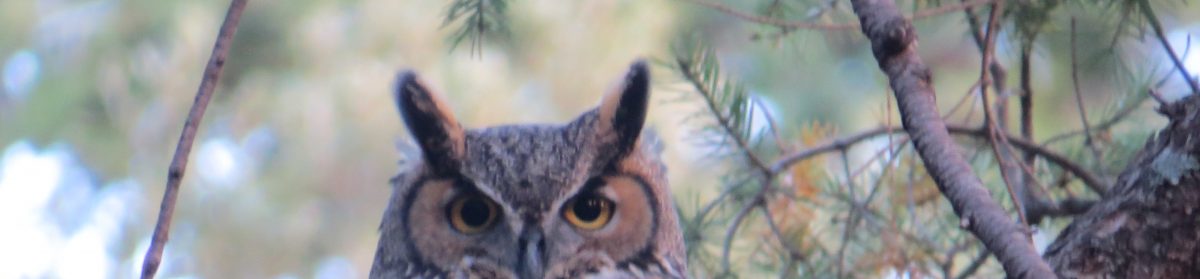
Barn Owl!

Finally! I got Barn Owl (537) tonight! For a bird listed as common here it took awhile to catch up with it. In fact this is the first one I’ve seen in Arizona. Thanks to my elite team of lookouts and informants, numbering in the thousands, spread out from coast to coast, I received a good tip recently from someone who knows someone with a nest box. Today I called this person who lives in Hereford with a nest box in his yard. Earlier this year there were 6 eggs in the box and later he saw 5 different Barn Owls in his yard. He told me he thought there would still be one roosting in the box if I would like to come over for a look. It sounded promising. At 5:30 this evening I arrived and saw the nest box in the back yard. The homeowner put up a step ladder and as he was about to open the box, out flew a Barn Owl. It circled the yard and landed on a light fixture on the side of the house:

Barn Owl, Hereford, Arizona

I didn’t want to approach too close and disturb it again so after a few shots I was done. Thank you Pat and thank you Elaine!

Corrigendum: The day after I got back from Ventura I listened to recordings of Allen’s Hummingbird. They were spot on to what I was hearing in the tall eucalyptus trees near the dock. There was at least one pair engaged in territorial disputes. I knew they weren’t Anna’s. So that’s number 536. Hopefully I will get a better look in San Diego in December.

I have a new goal for the Big Year. According to my reliable Big Year Department of Statistics, Bureau of Facts and Figures, Office of Best Guesses, I am on track to hit 570 for the year. So why not throw in some history and shoot for one more than Roger Tory Peterson counted in his Big Year in 1953. Roger and his English buddy James Fisher started in Newfoundland in April, worked their way down to Florida, across Texas (they dipped down into Mexico but didn’t count those birds in their totals), over to California, and up the West Coast to Alaska. All in one 100 day trip. Roger continued to count more species during the rest of the year and finished with 572, breaking Bob Smart’s record of 510 from the year before. My goal is now 573.

The only way I can do this is to pick up the pace. I have just finalized travel plans in December that will take me on a whirlwind coast-to coast final sweep of North America. From here I return to New Hampshire for several days to scoop up some very easy ticks for the list, and a few that will require a chase. From there I go directly to San Diego for my third and final West Coast tour, finishing with the grand finale in New Mexico at 10,000 feet. There are only a few more birds possible in Arizona and those, like Mountain Plover and Ruddy Ground-Dove, won’t show up until next month. The year is already drawing to a close, and so is this good day.

sunset, Huachuca Mountains, Arizona

the island jay

Ventura, California

“The West Coast has the sunshine, and the girls all get so tan….” Many of these places I visit this year, some for the first time in decades, spark dormant memories. Friday, as my plane coasted in to LAX, it occurred to me that it was 50 years ago this month that I first flew in to LAX when we moved to California. For years afterward I was teased about the first thing I said as we walked through the airport parking lot: “Look at all those California license plates!”

There are a handful of birds in North America that have a tiny range that is way off the beaten path requiring extra effort to see them. The best examples are Kirtland’s Warbler in Michigan and Colima Warbler in Big Bend National Park, Texas. Island Scrub-Jay is another. I’ve always wanted to see one but never had the chance. This year was the time to do it.

Day 1 – Friday, 19 October. I leave the apartment at 8:00 am, arrive at the airport at 9:20, leave Tucson on time at 10:50, and arrive at LAX at 12:20. By 1:30 I am on the road. I take the scenic route, Pacific Coast Highway, up to Ventura, passing through Topanga Canyon, Malibu, and all the A-List Southern California coastal towns on a stereotypical Southern California day – cloudless sky, calm air, low 70’s. Two hours later I check in to the Amanzi Hotel, carefully situated between downtown, Highway 101, and a train trestle. Most importantly, I am minutes from Ventura Harbor, where I immediately head so I’ll know where the boat is tomorrow.

After I find the dock, I walk across the street to the beach to look for Dunlin. Instead, I find something better:

Red Knot (with Black Oystercatcher) Ventura, California

Red Knot! (533) I may not see any more of these this year so this was a good find. I’ll get Dunlin later.

Day 2 – 20 October. Up at 7:00 and at the dock by 8:00 or so. The boat doesn’t leave until 9:30 so no need to get an early start. I have a ticket with Island Packers, purveyors of rides to the Channel Islands since 1969. Before we leave the dock I can see I am the only birder on board. The ride out takes much longer than usual due to heavy surf. Many times we have to slow almost to a stop to meet the bigger waves. I try sitting on the bow for a while but it’s like riding a bucking bronco and I’m afraid I’ll get tossed overboard. Within 20 minutes we see a species I expected we would – Black-vented Shearwater (534), about a dozen crossing the bow. Soon we would see groups of dozens on the water.

Two hours and twenty minutes after shoving off, we dock at Prisoner’s Cove, Santa Cruz Island. I scan the hillsides hoping for an early score. My anticipation level is high; I’m here, the only place on planet Earth where you can see this bird. I’ve come all this way, I must see one. The way it works, you land on the border between the national park and the rest of the island owned by the Nature Conservancy. If you want to enter Nature Conservancy land, you must join the ship naturalist. I ask and find that my best bet is to join the walk and then turn back when I’ve had my fill. A group of 8 of us heads up the trail and after half an hour, I see and hear nothing. Is today the one day when Island Scrub-Jay fails to show? Did I come all this way for nothing? I keep going. Then I see one! It lands in a distant snag right out in the open. I inform the guide there is one just up ahead. We reach the tree and out pops another one, right out in the open, Island Scrub-Jay (535)!

Island Scrub-Jay, Santa Cruz Island, California

I get all the pictures I want and, since I can’t do any better, I break off from the group and head back, head in the clouds. I got the bird I came here to see.

Soon I run into two local birders who have just seen a Varied Thrush. But first, they offer to show me a nest box of Saw-whet Owl, a bird they say is common on the island. But, no luck with the owl so I return to the thrush site and see a bird fly overhead that seems to have the color pattern of Varied Thrush, probably was the bird, but it got away without sufficient identification. I think I have Allen’s Hummingbird high in the tall eucalyptus trees near the dock but I can’t get a good look. Before I know it, it’s time to board the boat for the return trip to the mainland. I eat a good pizza blocks from the hotel and then join Cris and Al for the Sunday night game.

Day 3 – 21 October. I check out of the Amanzi at 8:00 and look for the Route 1 exit off 101 but I can’t find it, the morning sun is directly in my eyes and I can’t see the road signs. Instead of a scenic ride down Rt 1, I end up taking the 101 to the 405 to LAX. Needless to say, 20 mph was the going speed most of the way. Imagine doing that every day? I gas up the car, find the rental car drop off, ride the shuttle to the airport, and chill a few hours until the 1:10 departure, happy to let someone else drive for awhile. We arrive in Tucson by 2:30, where it is many degrees cooler than in LA. I stop at the railroad trestle along the way to look for Barn Owl but no luck. I may have a new lead on that one later this week, let’s see what happens. The trip is over and I’m thrilled with how it went. In two weeks I leave for Texas.

the 007 bird

(I sent this out 2 days ago but now I don’t see it!)

It’s a secret. I can’t tell you too much. I can tell you what and when but not who and where. You already know why. I’ve already said too much. It’s that classified. This is a big one. Last summer a birder in Sierra Vista, I’ll call him … ummmmm…. “John”, offered to take me and one other person to see this bird but I was away. They saw it and so now I had to see it. Last week I asked John if his offer was still good. It was.

Tuesday morning we set out for a long drive. On the way up a long dirt road I called out what I thought was a turtle in the road. Close – it was a reptile, the baddest one around, Gila Monster.

Gila Monster, “somewhere” in Arizona

On up the road we continued, one with some bad sections. This is the kind of road that should only be driven with a rental car. We came upon a stone cairn John built last summer. “Park here,” he ordered. We got out and started exploring the area. Reluctantly I played some tape play back. A bird responded right away. We headed toward it and then it stopped calling. I vocalized and the bird answered. I got close enough to see small birds, mostly Verdins and Black-tailed Gnatcatchers, mobbing something but I couldn’t see the target. We tried going up the wash and then back down. We heard the bird again and gave chase but once again it was not in the tree it was calling from. Ready to try a different site, we stopped when we heard the bird call again. John tooted and it responded. A short chase and he found the bird! Just as I looked at it, a gnatcatcher that was mobbing it chased it away. John called and the bird answered, always moving a little farther. Finally I caught up with it, and was fortunate enough to get a good photograph of Ferruginous Pygmy-Owl (532) (ABA 646).

Ferruginous Pygmy-Owl, Arizona

The photograph shows the brown breast streaking, the streaked, not spotted, crown, and other photographs show the rufous banded tail, eliminating Northern Pygmy-Owl. There are only two places in North America to see this species: far south-central Arizona and the southern tip of Texas. But in Texas you can get a tour to see them on King Ranch served up like spare ribs. Here you have to dig them out by hand. We used some tape playback but mostly our own owl vocalizations. Arizona hosts the federally endangered cactorum, or “Cactus” subspecies, named for its affinity with saguaro cactus. I didn’t count on seeing this bird this year so it’s a big plus for the list.

Two more mammals were added to the Big Year mammal list, Antelope Jackrabbit, found only in south-central Arizona within the United States, and Harris’s Antelope Squirrel. Oh, and we saw a yellow-shafted flicker that, out here, I think I am safe to call Gilded without giving it a DNA test. Saturday I fly to LA for a shot at Island Scrub-Jay.

still looking

Wouldn’t that make a great song title? Or maybe it’s “Still Lookin'”. “I’m lookin’ high, I’m lookin’ low/lookin’ every place that I go. Just can’t find what I’m lookin’ for/can’t be bought, not in any store….” Is it about birding? Mate selection? Keep it cryptic.

A few nights ago I went for a drive under a high and nearly full moon hoping to intersect with a Barn Owl. The odds are pretty low. I’ll have to find one roosting somewhere. Meanwhile, I’m getting ready for some new trips. The pace quickens as we reach the end of the year. Next week I’m off to Santa Cruz Island for a visit with Island Scrub-Jay. Two weeks later it’s a Texas redux in Harlingen at the Rio Grande Valley Birding Festival to look for some of the targets I missed in April. December takes me back to the West Coast for a few days in San Diego and probably Salton Sea. From there I really should go to New Hampshire to pick up ten to twelve easy-to-not-so-hard winter birds. I may finish the year with a grand finale atop Sandia Crest.

My mail man is my best friend these days. From the stacks of mail he brings me I shall now – live! – pull an envelope out of the pile purely at random. I won’t first feel to see if it is five pages or if there is a photograph inside. No looking at the return address or the country of origin of the stamp. I will simply reach in and pull one out. Without prejudice. Here we go. I got one. I’m opening it up. Unbelievable! By sheer coincidence, I am written to by an admiring fan from overseas who is well known in her country. “Modela” writes me from Buenos Aires, Argentina. She doesn’t tango, she says, but instead is – not surprisingly – the newest sensation in all the fashion magazines down there. Not coincidentally, she goes by the nickname “Avita”, little bird. She is beginning to travel globally now and would like to connect with me in New York for her next big shoot. Included in her envelope – and you knew this was coming – is her head shot, autographed on the back just for me:

“Avita”

Thank you, Avita, I am as flattered as you are beautiful. I should like to take you by the wing and show you my country. Together we could soar to new heights.

second thoughts

Last January 23, I reported Gilded Flicker as number 143 for the year. But after thinking it over, I realized I did not get a god enough look at it to eliminate the possibility of a hybrid with Northern Flicker. I need to get a good Gilded somewhere in or around Tucson.

I also need Barn Owl. I discovered that for two weeks in a row the field trip at Canoa Ranch Conservation Park in or near Green Valley had seen Barn Owl. They must know where one roosts. So I teamed up with my good birding buddy Joy in Green Valley to go on the Saturday field trip and then go search for the flicker.

On my way over to Green Valley I stopped in at Santa Rita Lodge in Madera Canyon to watch the feeders for awhile. Not much was happening until a certain bird caught my eye, one I had been looking for but had never seen, that I could think of:

Lesser Goldfinch, Santa Rita Lodge, Madera Canyon, Arizona

Both birds are the same species but look how different they appear. The one on the right is the black-backed or Texas subspecies, psaltria, rarely seen around here. It’s hard to find birders interested in subspecies but we should be, it’s another layer of ID that takes you that much deeper. I like how the common green-backed subspecies just happens to be on the same feeder at the right time for comparison.

So Friday afternoon we scoped out the Canoa Ranch to see if we could find our own Barn Owl. Instead we fortuitously ran into Brian Nicholas, who leads the weekly walk here, who told us the owl wasn’t there yesterday and that it was unlikely they would search for it tomorrow, but he knew of another one and gave us directions. Saturday those directions took us to a certain train trestle where we looked up but saw no owl. The train action was good though, one west-bound freight and one east-bound Amtrak. From there we went up to Saguaro National Park – East for the flicker.

Saguaro National Park, Arizona

Our system was to stop at all the pullouts and scan the saguaros. At the first stop we found a distant flicker perched atop a cactus. It looked good. “Get your scope,” I directed Joy. Out came this clankety old device manufactured some time around the fall of the Roman Empire. “Where’s the zoom?”, I urgently pleaded. “There is no zoom”, came the somber reply. No zoom?!?!?! No zoom. Just because I could identify this bird with a zoom doesn’t mean I was disturbed. No, that’s ok, there are bound to be other Gilded Flickers much closer.

We continued on, stopping and scanning, stopping and scanning, for the whole length of the park drive. We heard some flickers, saw a few more, but nothing close enough to allow me to be certain. I didn’t come all this way to say: “close enough.” I missed Gilded Flicker all for the love of my spotting scope, you know, the one with the 60X zoom, that I forgot! I still have time. We are now early in the fourth quarter so there is plenty of time. Steady, my boy. I’ll just have to go back, bring my scope, and find Gilded Flicker.